Learn FPV Drones in 2026: My Crash-to-Cruise Guide
The first time I tried FPV, I lasted about six seconds before lawn-darting an imaginary quad into a virtual tree. It was humiliating—and weirdly addictive. Oscar Liang’s beginner guide (updated April 2025) became my flashlight in a hobby that feels like half video game, half soldering apprenticeship. In this post I’m going to tell the story the way it actually happened for me: the simulator obsession, the gear rabbit holes, the “why is my VTX nuking someone’s goggles?” moment at a meetup, and the slow shift from fear to flow.
TL;DR: Start with 10+ hours in an FPV training simulator using a real radio, learn Acro, buy a tiny whoop as your first real drone, then graduate to a 5-inch. Budget $400–$1,800, pick a solid radio (ELRS 2.4GHz), choose an FPV system (analog vs DJI/Walksnail/HDZero), and take safety + community etiquette seriously.
1) The ‘Sim First’ Rule I Tried to Ignore (and couldn’t)
My not-proud moment: Acro chaos before “throttle management”
I wanted to learn FPV drones the fast way: buy a quad, rip a field, post the clip. Then I tried Acro (manual) mode for the first time and instantly discovered a humbling truth—my thumbs had confidence, but zero skill. I punched the throttle like it was a video game trigger, the quad rocketed up, rolled over, and “died” in the grass. I didn’t even know the phrase throttle management yet… but I was already failing it.
Why 10+ hours in an FPV drone simulator saved my wallet
That’s when Oscar Liang’s line hit me like a warning label:
“If you can’t keep it in the air in a simulator, the real world will just charge you for the same lesson.”
So I committed to a minimum 10+ hours of simulator practice FPV before touching real props again. That time in an FPV training simulator didn’t just teach moves—it built muscle memory at zero cost per crash. Every reset button was money I didn’t spend on arms, motors, and bent pride.
My “workout plan” rotation: Liftoff, Tryp, Velocidrone
I treated each FPV drone simulator like a different drill:
Liftoff for fun freestyle flow and maps that kept me practicing longer.
Tryp FPV for cruising lines that felt closer to real flying.
Velocidrone for tight control and repetition when I needed discipline.
No Xbox pad—my real radio only
Using my actual FPV radio controller mattered more than I expected. An Xbox controller was tempting, but it didn’t teach the same stick feel, tension, or tiny corrections. The whole point of an FPV drone training phase is to make your hands automatic.
Acro isn’t “hard”—it’s honest
One day it clicked: Acro doesn’t fight you or save you. It simply shows what you did. Simulator hours felt like learning to skate on carpet before ice—awkward, slow, but safe.
Mini-milestones on my beginner FPV roadmap
First clean lap
First power loop
First controlled landing
By then, the 2026 beginner FPV roadmap finally made sense: simulator → tiny whoop → larger quad. The sim wasn’t a delay—it was the shortcut.
2) My Budget Reality Check: $400 vs $1,800 (and the ‘Oops’ Costs)
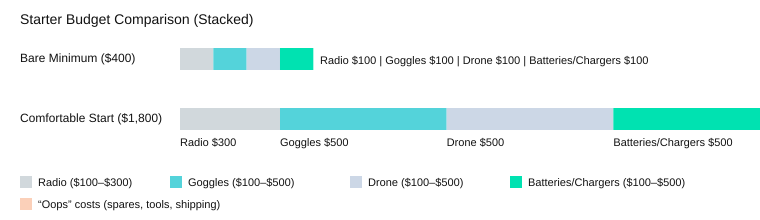
When I started starting FPV in 2026, I did what every nervous beginner does: I made a spreadsheet. I copied Oscar Liang’s ranges into neat rows—radio $100–$300, FPV goggles options $100–$500, drone $100–$500, and supporting gear (batteries/chargers/tools) $100–$500. Total: $400–$1,800. Easy… until I realized I’d forgotten the line item that makes everything fly: chargers and batteries. That was my first “oops” cost.
My real-world shopping math (aka: why $400 is possible, but tight)
The $400 end of this beginner FPV guide is real, but it’s a narrow path: basic analog goggles, a simple quad, and the minimum safe charging setup. The $1,800 end felt like breathing room—better goggles, more reliable gear, extra packs, and fewer “why won’t this bind?” nights.
Where a ready to fly kit feels magical (and where it caps you)
I kept circling two FPV essentials kit options: the BetaFPV Cetus X FPV Kit and the DJI Avata 2 kit. RTF bundles are beginner-friendly for learning manual/acro without building stress. DJI’s ecosystem is the “easy button” for many beginners, while Walksnail, HDZero, and analog are solid alternatives depending on budget and latency needs.
But the magic has a ceiling: included radios and goggles can become the first thing you outgrow, especially once you want more range, better video, or a different drone (hello, HGLRC builds).
My rule: buy the radio first
If I could redo it, I’d still start with a good radio (often ELRS). Drones and goggles change; muscle memory doesn’t.
George (Lancashire): “I was a click away from a random Amazon bundle—posting my parts list saved me from buying twice.”
Budget | Radio | Goggles | Drone | Batteries/Chargers | Total |
|---|---|---|---|---|---|
Bare Minimum | $100 | $100 | $100 | $100 | $400 |
Comfortable Start | $300 | $500 | $500 | $500 | $1,800 |
3) The Radio Is My ‘Steering Wheel’: FPV Radio Controllers + ELRS 2.4GHz
Early on, I treated my transmitter like an accessory—something you buy because the drone needs it. Then the sim humbled me. In Liftoff and Velocidrone, the “drone” was just pixels, but my FPV radio controller was real. Every crash was my thumbs, not the quad. That’s when it clicked: modern FPV is basically two systems—the body (frame, motors, props) and the brains (camera/air unit, goggles, radio controller). The radio is the part that teaches you to fly.
Why ExpressLRS 2.4GHz became my default
Oscar Liang’s transmitter guide pushed me to stop guessing and pick what the community actually trusts. In my circle, ExpressLRS 2.4GHz was the default recommendation because it’s the most popular and reliable protocol, easy to find on new gear, and it just “stays connected” when you’re learning FPV drone basics. As a beginner friendly FPV choice, it removed one big worry: “Is it me… or my link?”
Box vs gamepad: my one-week comfort debate
I went back and forth for a week. Box radios felt like a small instrument panel—stable in my hands, lots of switches, great for pinching. Gamepad radios felt familiar and light, like a console controller but with real gimbals. In the end, I cared most about gimbal feel and consistency. Smooth center, predictable tension, no sticky corners. That’s what built my muscle memory.
My personal “nope” list
Xbox/PlayStation controllers (fun, but they don’t teach nuance)
Keyboard flying (binary inputs = bad habits)
Anything that makes Acro feel “twitchy” instead of precise
Alex’s time-travel moment (Frsky Taranis 9xd plus)
Alex: “I powered up my Taranis 9XD Plus and realized the hobby moved on without me—ELRS felt like switching from dial-up to fiber.”
The tiny habit that helped most
Before every session—sim or real—I did the same stick “scales” for 60 seconds:
Slow roll left/right, return to center
Slow pitch forward/back, return to center
Gentle yaw holds, then stop clean
Throttle ramps: 0→30→0 without bouncing
4) FPV Drone Sizes: From Tiny Whoop Therapy to 5-Inch Confidence
When people ask me about FPV drone sizes, I tell them it’s less about inches and more about how brave you feel that day. For FPV drones beginners, size decides where you can fly, how often you crash, and how expensive those lessons get.
Tiny whoop drone life: indoor lines and “how did it survive?”
My first real progress didn’t happen outside—it happened in my hallway with a tiny whoop drone. Palm-sized, ducted props, and built for bouncing off door frames like it’s part of the plan. I’d clip a chair leg, tumble, and still take off again. That durability turned fear into reps, and reps into control.
The size categories I use (and why they matter)
Category | Prop size | Best for | Typical traits |
|---|---|---|---|
Small | < 4 inch | Indoor, tight parks, practice | Often under 250g, cheaper crashes, less wind power |
Medium | 4–6 inch (5” most popular) | Freestyle, racing, general learning | Most parts/options, strong performance, “standard” feel |
Large | 7 inch+ | Long range cruising | Efficient, stable, needs space and planning |
When I understood why 5-inch is the gold standard (and why it scared me)
The first time I watched a 5-inch rip past, it didn’t look like a toy—it looked like a machine. Oscar’s numbers stuck in my head: 600–800g with the battery, and 150+ km/h on tap. That weight and speed matter because mistakes carry farther, hit harder, and break more.
Joshua Bardwell: “A 5-inch quad is the small-block V8 of FPV—common, upgradeable, and it teaches you everything fast.”
The under-250g temptation (and my graduation plan)
I get why people chase micros: under 250g can mean less rules baggage, easier travel, and safer practice in tighter spaces. My path became simple: tiny whoop → 4-inch/micro → my first real drone (5-inch).
A daydream detour: X-class monsters
Sometimes I still window-shop X-class builds—huge props, huge noise, huge “not yet.” I don’t need one. I just like knowing there’s always a bigger level waiting.
5) FPV Flying Styles: Picking a ‘Personality’ (Freestyle, Racing, Cinematic, Long Range)
Once I got past the “what quad should I buy?” panic, I hit a bigger question: who am I in the air? In 2026, the big four FPV flying styles still shape everything—frame size, batteries, video system, and even how you think.
Freestyle FPV flying: skateboarding in the sky
Freestyle FPV flying is where I learned to breathe again after crashing in the sim for hours. It’s creative, close-in, and all about control—power loops, dives, reversals—usually on a versatile 5-inch with punchy batteries. It felt like skateboarding, except the “park” was a bando and the consequences were real carbon fiber.
Steele Davis: “Freestyle isn’t about going far—it’s about making ten meters look like a movie.”
FPV drone racing: the low-latency obsession
FPV drone racing is pure reaction time. Gates come fast, and your brain starts measuring life in milliseconds. That’s why HDZero kept coming up in every race chat: low latency, consistent feel, fewer “surprise” moments. Racing builds often go lighter and stiffer (5-inch and smaller), with battery choices aimed at burst power, not long hang-time.
Cinematic FPV flying: smooth throttle fingers
Cinematic FPV flying taught me patience. Cinewhoops shine in tight spaces and near people (still risky—props are props), while cinelifters exist to haul real cinema cameras. The goal isn’t tricks; it’s clean lines, gentle yaw, and steady throttle. Bigger rigs often run larger batteries for stable voltage and longer takes.
Long range FPV: when the goal is trust
Long range FPV is where my mindset flipped from “send it” to “check it.” Efficient 7-inch cruisers, calmer rates, and links like Crossfire or ExpressLRS matter more than style points. I started caring about GPS rescue, failsafes, and staying under 400 ft (US) or 120 m (Europe).
My honest self-assessment quiz
If nobody’s watching, do I chase lines (cinematic) or tricks (freestyle)?
Do I crave lap times (racing) or range (long range)?
Do I enjoy tuning and reliability checks, or just flying now?
Wild-card: one quad for a year
If I could keep only one, I’d pick a simple 5-inch freestyle build—because it can dabble in every style, and it keeps my skills sharp even on boring days.
6) FPV Drone Systems: Analog vs DJI vs Walksnail vs HDZero (My ‘Goggles Envy’ Phase)
The first time I looked through crisp digital goggles, my brain said “wow,” and my wallet said “please no.” That was my real entry into FPV drone systems: not specs, not charts—just instant jealousy. I’d been happily crashing in a sim, then suddenly I was deep in an FPV system comparison spiral.
Oscar Liang: “There’s no single best FPV system—only the one that matches your flying and your tolerance for troubleshooting.”
Analog FPV system: still the smart choice for cheap crashes
The analog FPV system looks “old” on YouTube, but it’s still the easiest way to learn without fear. For Tiny Whoops and backyard beaters, analog is light, tough, and affordable. When I bounced off a wall (again), replacing parts didn’t feel like a financial event. Analog also keeps things simple: less heat, less weight, fewer “why won’t it link?” moments.
DJI FPV system: the clarity trap (DJI O3 / DJI O4 video)
The DJI FPV system is marketed as the beginner-friendly, premium lane—and I get why. The DJI O3 air unit (often written as DJI O3 air) and newer DJI O4 video / O4 Pro buzz promise that “how is this even real?” image. Digital FPV systems like these are marketed as up to ~10 km transmission (conditions and rules vary) and up to 4K high frame rate onboard capture. The comfort is real. The price sting is also real.
Walksnail: “wait, this is actually really good”
Walksnail surprised me. It felt like a strong digital FPV system option when I wanted HD without fully buying into DJI’s ecosystem. Community chatter often frames it as the practical alternative: solid image, improving gear, and more choice in builds.
HDZero: why racers talk about latency like it’s a religion
HDZero is where I learned the word latency can start arguments. Racers love it because it’s built around low delay and consistent feel—more “connected,” less floaty.
My coping strategy: pick by where you fly
Indoors / Tiny Whoops: analog
Freestyle + pretty footage: DJI O3/O4 or Walksnail
Racing: HDZero
7) Building vs Buying: FPV Drone Components and the ‘Soldering Confidence Curve’
Why building felt like LEGO… if LEGO required a multimeter
Buying my first quad was tempting. One click, shiny photos, instant “pilot.” But building called to me—until I realized it’s like LEGO… if LEGO required a multimeter, calm breathing, and the ability to re-do the same solder joint three times without spiraling.
The weird part? The fear dropped fast. Each battery lead I soldered moved me up what I now call the soldering confidence curve: shaky hands → “okay, that held” → “wait, I can fix this in the field.”
FPV drone components I learned to name without Googling
Once I stopped treating it like magic, the core FPV drone components became a simple list:
Carbon fiber frame + metal hardware (the FPV drone body)
Motors and props (thrust and chaos)
FC (flight controller) and ESCs (the control stack)
FPV video system (analog, DJI, Walksnail, HDZero—aka FPV system 2026 choices)
My mental model: FPV drone body vs FPV drone brains
Oscar Liang’s guides helped me split everything into two buckets: the FPV drone body (frame, motors, props) and the FPV drone brains (camera/air unit, goggles, radio controller, plus the FC running Betaflight or iNAV). That one idea stopped me from mixing incompatible parts at 1 a.m.
My “future-proof” choice: BLHeli32 + DShot600
I picked ESCs with BLHeli32 and ran DShot600 because I wanted clean digital signaling and modern features without instantly outgrowing my stack. It also made troubleshooting feel less like guessing and more like process—especially once I started logging and adjusting Betaflight settings 2026.
Chris Rosser: “Most ‘mystery oscillations’ aren’t mysteries—your build choices and tuning just haven’t met each other yet.”
Pre-built pitfalls + my IntoFPV sanity check
RTF and pre-builts can be great, but I learned to watch for outdated electronics hiding behind glossy listings. Before I clicked “buy,” I posted my parts list on IntoFPV.com. That one habit—plus Oscar’s blog—saved me from mismatched connectors, weak VTX choices, and “why doesn’t this fit?” surprises.
8) Tuning, Logs, and the Day I Fell in Love With Blackbox
The “it flies… kinda” stage (aka: why my thumbs felt betrayed)
After all that FPV drone training in sims, my first real quad did lift off… but it wasn’t fun. It wobbled on punch-outs, bounced after flips, and sounded “angry” in the air. I’d joined a local FPV group before flying (best safety tip I stole from the community), and the veterans all said the same thing: “Congrats. You’re at the it flies… kinda stage.”
Oscar Liang: “Tuning is where your drone stops being a parts list and starts being yours.”
Blackbox logging (how I used it without pretending I’m an engineer)
Oscar’s tuning tutorial finally made Blackbox feel less like rocket science. I didn’t try to understand every graph. I just looked for obvious stuff: noisy gyro traces, motor saturation, and weird spikes right when the quad shook. Blackbox became my truth serum—especially when my “fix” was actually making things worse.
PID tweaks: tiny changes, huge difference
I learned fast that “more P” isn’t a personality trait. The biggest wins came from small steps: a little less D to calm hot motors, a touch more filtering when the logs looked messy, and backing off rates when my flying was the real problem. That’s the heart of a beginner FPV guide: change one thing, test, repeat.
My Betaflight ritual (Betaflight settings 2026)
By 2026, my Betaflight settings 2026 routine is boring on purpose:
Save a diff before touching anything:
diff allLabel it like a scientist: “v3_moreD_hotmotors”
Don’t change five things at once (I did; I regretted it)
iNAV cameo (why long-range folks swear by it)
When I started flirting with long-range, friends pushed iNAV for its navigation features and “get-home” style tools. Betaflight felt like a sports car; iNAV felt like a touring bike with a map.
A messy aside: I chased vibrations for hours… and it was a bent prop
One night I blamed my frame, my motors, even “bad firmware” (classic). Blackbox showed vibration peaks, I tweaked filters, re-soldered a ground… then noticed a slightly chewed prop. New prop on, perfect flight. Dumb fix. Best fix.
9) FPV Drone Safety: Rules I Follow So I Can Keep Flying Tomorrow
I learned FPV drone safety the same way I learned Acro: by messing up, then building habits that remove “luck” from the equation. Simulator time helped a lot—those 10+ hours in Liftoff/Velocidrone with my real radio meant fewer dumb crashes when props were real.
Props are not toys: my “hands away” arming routine
Every time I plug in, I assume the quad can bite. Before I arm, I do a quick ritual:
Quad pointed away from me and everyone else
Hands off the frame (no “one more tweak” while powered)
Goggles on or eyes locked on the drone—no distractions
That routine sounds boring until you remember props don’t “cut”—they shred.
LiPo reality: my FPV drone battery rules (my mini FPV battery guide)
The FPV drone battery is the part I never gamble with. I pick LiPos that match my build and style—voltage (like 4S/6S), capacity for flight time, and C rating for punch. If I’m unsure, I ask my local group before buying.
Storage: LiPos go to storage voltage and into a LiPo bag/metal box.
After a crash: if a pack is puffy, torn, or smells sweet/chemical, it’s done.
Disposal: I follow local drop-off rules—no “toss it in the trash” shortcuts.
Where I refuse to fly (even if it’s tempting)
I don’t fly crowds, tight parks, or anywhere my gut says “not today.” If I can’t maintain a safe buffer, I leave. That’s not fear—it’s planning.
Altitude limits I check (even when nobody’s watching)
I keep the common limits in my head: 400 ft in the US and 120 m in much of Europe. I check local rules anyway, because “common” isn’t always “legal.”
Insurance, responsibility, and meetup etiquette
Insurance felt like paperwork—until it felt empowering. I’m choosing to be accountable.
And at meetups, I always check my VTX channel before powering on. I once “blinded” another pilot mid-flight by being careless. I won’t repeat that.
Ken Heron: “The best pilots aren’t the bravest—they’re the ones who still have all their fingers and keep showing up.”
10) Long Range FPV: The 7-Inch Daydream (and the Practical Checklist)
My first long range FPV daydream wasn’t about tricks—it was about distance. It felt like hiking: slower, quieter, and way more planning than people think. When you’re pushing FPV drone range, the goal isn’t “send it.” The goal is “come back.”
Why a 7 inch long range build changes your mindset
A 7 inch long range quad is where I stopped thinking like a sprinter and started thinking like a camper. Bigger props usually mean better efficiency, smoother cruising, and less frantic throttle. In 2026, most long range FPV drone builds I see are 7-inch and above, paired with GPS, long range antennas, and reliable control links. I didn’t rush into it because every upgrade adds complexity—and complexity is where mistakes hide.
The practical checklist I run before any long range drone flight
GPS lock and home point set (I wait, even when I’m impatient).
Failsafe behavior tested on the bench (what happens if signal drops?).
Return plan: wind direction, turnaround battery %, and a “no-lower-than” altitude.
Antennas: secure mounts, correct polarization, and no cracked coax.
Video link checked for range and penetration where I’m flying.
Rules: local limits (400 ft US / 120 m EU), no crowds, and legal spotter if required.
Systems that kept popping up: ELRS, Crossfire, and DJI O4
For control, ELRS (especially 2.4GHz) kept showing up as the default “works everywhere” choice, with Crossfire still respected for long range reliability. For video, 2026 builds often lean digital—DJI O4 gets mentioned a lot for stable HD footage, especially when paired with proper long range antennas.
AndyRC: “Long range FPV is 80% planning, 15% restraint, and 5% pure magic.”
My expectation benchmark (not a promise)
I used the Chimera7 Pro class as a reality check: commonly cited numbers are around ~86 mph top speed and ~30 minutes flight time—depending on tune, payload, wind, and battery.
Metric | Typical reference |
|---|---|
Common frame size | 7 inch and above |
Example performance | ~86 mph (varies widely) |
Example endurance | ~30 minutes (varies widely) |
The big lesson: long range FPV is mostly preparation, not heroics.
11) Cinematic FPV Drones: Smooth Footage, Tight Spaces, Big Feelings
I didn’t fall in love with cinematic FPV drones because they were fast. I fell in love because they made ordinary places feel like scenes. A hallway became a “one-take.” A backyard became a set. And in cinematic FPV 2026, the goal is clear: stabilized 4K capture (settings and platforms vary), clean lines, and repeatable results.
Cinewhoops: why ducts made me braver (and my footage steadier)
A cinewhoop is a small FPV quad with prop ducts, built for close flying near people and objects (still risky—props are props). The ducts changed my mindset. I stopped flinching at door frames and started thinking about camera moves. My turns got smoother because I wasn’t “saving it” every second; I was guiding it.
Cinelifters: the moving-day trucks of FPV
A cinelifter is the opposite vibe: big frame, big power, built to haul serious cinema cameras. When I watch cinelifter footage, I can feel the weight in the motion—like a crane shot that happens to fly.
Johnny Schaer: “Cinematic FPV is choreography—you’re not chasing adrenaline, you’re chasing intention.”
My mini-rules for cinematic FPV flying in 2026
Fewer stunts, more consistency: one clean pass beats five messy tricks.
Fly slower than you think: speed reads as “FPV,” not “movie.”
Pick one subject: a person, a car, a doorway—then commit.
Beginner-friendly cinematic options (what I’d tell a friend)
If someone asked me today, I’d point them at the DJI Avata 2 vibe: durable frame, confidence in tight spaces, and a reliable digital link through the DJI FPV system. In the same beginner-friendly lane, DJI Neo also fits the 2026 trend: stable-looking 4K, practical flight time, and less fuss.
Stabilization expectations: “movie” vs “still FPV”
Stabilization can smooth bumps, but it won’t hide bad throttle control. If your horizon wobbles, it still feels like FPV—just cleaner FPV.
A 30-second shot list (before the battery even plugs in)
3s: slow reveal from behind an object
10s: follow at walking speed
10s: orbit once, steady altitude
7s: gentle push-in to a stop
12) Community, Etiquette, and the Part Nobody Can Buy
IntoFPV.com felt like a repair shop waiting room—in the best way
When I was deep in my beginner FPV guide phase, IntoFPV.com and Oscar Liang’s blog didn’t feel like “websites.” They felt like that waiting room where everyone’s holding a cracked frame, a toasted ESC, or a bruised ego—and nobody judges you for it. I’d read Oscar’s posts (part of a knowledge base updated from 2015–April 2025) and then cross-check my plan with real people who had already made my exact mistake.
Posting my parts list before buying: the cheapest insurance I’ve ever purchased
Before I spent money, I posted my parts list. Every time. It saved me from mismatched connectors, weak motors, and “why won’t this bind?” headaches. In a world where a Torvol or Lowepro bag can’t protect you from bad choices, community feedback can. It’s the most beginner friendly FPV move I know.
Meetups: channel checks, spotters, and the unspoken “don’t be a hero” rule
My first meetup taught me etiquette fast: check your VTX channel before powering up, call out takeoffs, and use a spotter when it’s smart. Nobody wanted a surprise mid-air video blackout. And nobody respected the pilot who flew too close to people “just to prove it.” Simulator hours first, real flights later—safety guidance is right: it cuts crashes and builds calm hands.
Watching others crash taught me what gear never will
I watched great pilots lawn-dart and laugh, then open Betaflight logs or tweak iNAV settings like it was normal—because it is. Crashes were shared, fixes were shared, and so was the confidence to try again.
Oscar Liang: “FPV is a journey—crash, fix, learn, repeat. The community is what makes the repetition enjoyable.”
Data | Value |
|---|---|
FPV speed world record (as cited) | 360 km/h |
Record date | January 3rd, 2023 |
Content update span | 2015–April 2025 |
In the end, this FPV drones guide for FPV drones 2026 lands on one truth: you can buy a Radiomaster, fancy goggles, and a fast quad—but you can’t buy patience. You earn it through sim time, kind advice, safe meetups, and the quiet pride of getting back in the air. That’s the real hobby. That’s the part that lasts.


